The capabilities of Large Language Models (LLMs) are enhanced by Retrieval-Augmented Generation (RAG). Thus, RAG comes up with a super powerful technique that distinguishes it from others.
RAG Frameworks are tools and libraries that help developers build AI models that can retrieve relevant information from external sources (like databases or documents) and generate better responses based on that information.
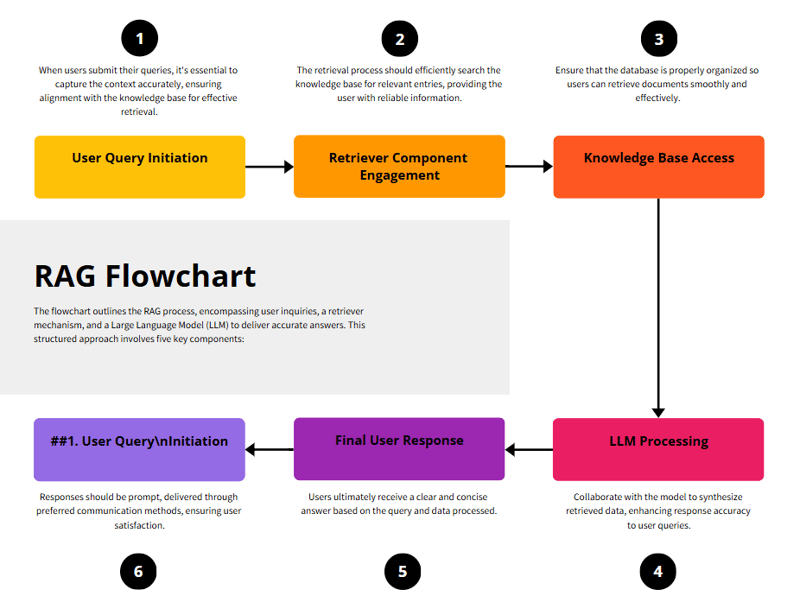
RAG and it's Flowchart 🎴
Imagine you have a big toy box filled with all your favorite toys. But sometimes, when you want to find your favorite teddy bear, it takes a long time because the toys are all mixed up.
Now, think of RAG (Retrieval-Augmented Generation) as a magical helper. This helper is really smart! When you ask, "Where is my teddy bear?", it quickly looks through the toy box, finds the teddy bear, and gives it to you right away.
In the same way, when you ask a computer a question, RAG helps it find the right information from a big book before giving you an answer. So instead of just guessing, it finds the best answer from the book and tells you! 😊
RAG=RetrievalBasedSystem+GenerativeModels
Flowchart
RAG OverSimplified
How RAG Frameworks Work ⚒️
Retrieve → Search for relevant documents using a vector database.
Augment → Feed those documents into the LLM as extra context.
Generate → The LLM generates an informed response using both retrieved data and its own training knowledge.
Example
🔹 Step 1: User Question
Example: "Who discovered gravity?"
🔹 Step 2: Retrieve Relevant Information
Searches a knowledge base (e.g., Wikipedia, company documents)
Finds: "Isaac Newton formulated the law of gravity in 1687."
🔹 Step 3: Augment & Generate Answer
The LLM takes the retrieved information + its own knowledge
Generates a complete, well-structured response
🔹 Step 4: Final Answer
Example: "Gravity was discovered by Isaac Newton in 1687."
I hope now you're somewhat clear with the Rag concept. Now, in this blog, we will be discussing the top 10 Open-Source RAG frameworks that will help you boost your project or enterprise.
Top 10 Open-Source RAG Frameworks you need!! 📃
Here's a curated list of some famous and widely used RAG frameworks, you might not want to miss:
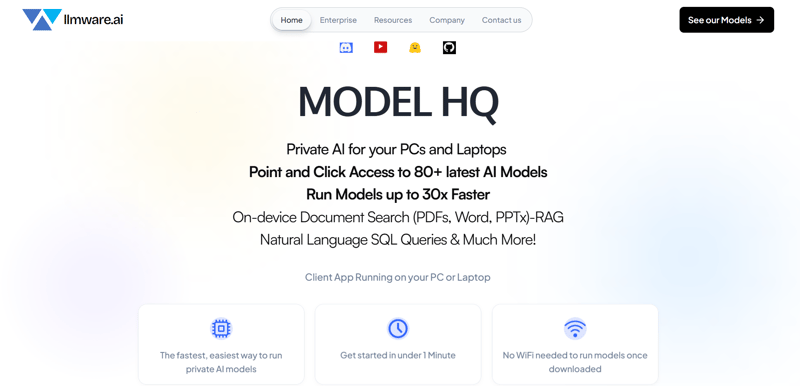
LLMWare provides a unified framework for building LLM-based applications (e.g., RAG, Agents), using small, specialized models that can be deployed privately, integrated with enterprise knowledge sources safely and securely, and cost-effectively tuned and adapted for any business process.
Unified framework for building enterprise RAG pipelines with small, specialized models
llmware
🧰🛠️ Unified framework for building knowledge-based local, private, secure LLM-based applications
llmware is optimized for AI PC and local laptop, edge and self-hosted deployment across a wide range of Windows, Mac and Linux platforms, with support for GGUF, OpenVINO, ONNXRuntime, ONNXRuntime-QNN (Qualcomm), WindowsLocalFoundry, and Pytorch, providing a high-level interface that makes it easy to leverage the right inferencing technology optimized for the target platform.
llmware has two main components:
Model catalog with 300+ models - models prepackaged in quantized, optimized formats, to leverage on device GPU and NPU capabilities, with support for major open source model families and 50+ llmware finetuned SLIM, Bling, Dragon and Industry-Bert models specialized for key tasks in enterprise process automation. Also supports leading cloud models from OpenAI, Anthropic and Google.
RAG Pipeline - integrated components for the full lifecycle of connecting knowledge sources to generative AI models with wide range of document parsing and…
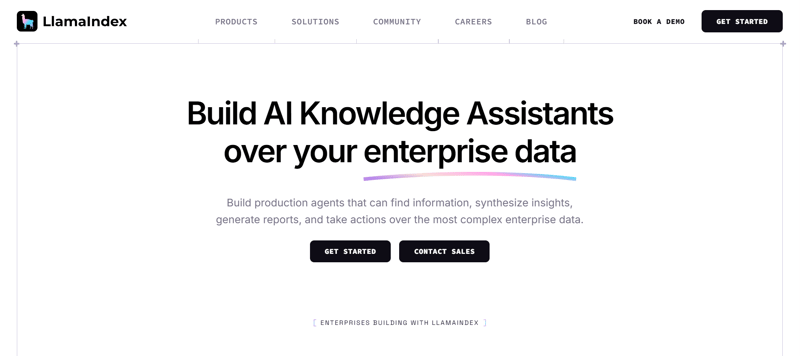
LlamaIndex (GPT Index) is a data framework for your LLM application. Building with LlamaIndex typically involves working with LlamaIndex core and a chosen set of integrations (or plugins).
Core Features
Indexing & Retrieval – Organizes data efficiently for fast lookups.
Modular Pipelines – Customizable components for RAG workflows.
Multiple Data Sources – Supports PDFs, SQL, APIs, and more.
Vector Store Integrations – Works with Pinecone, FAISS, ChromaDB.
LlamaIndex is the document processing platform for AI
🗂️ LlamaIndex (OSS Framework) 🦙
Note
The current focus of LlamaIndex is to build the best AI-powered engine for document parsing and extraction. LlamaParse is our enterprise platform for agentic OCR, parsing, extraction, indexing and more. LiteParse represents our efforts to build the best free, fast, cheap text parser in the market. ParseBench and ExtractBench represent our commitment towards open benchmarking for parsing and extraction.
The company itself has undergone an evolution since when this OSS framework first launched 3 years ago in 2023. Since the early days, the framework has consisted of a broad set of orchestration tools enabling developers to build various RAG and agent applications.
While we still have the OSS framework available as an open toolkit that you're welcome to use, our primary focus has shifted towards LlamaParse, along with liteparse and our benchmarking efforts. We have a strong belief that agents are the new consumers…
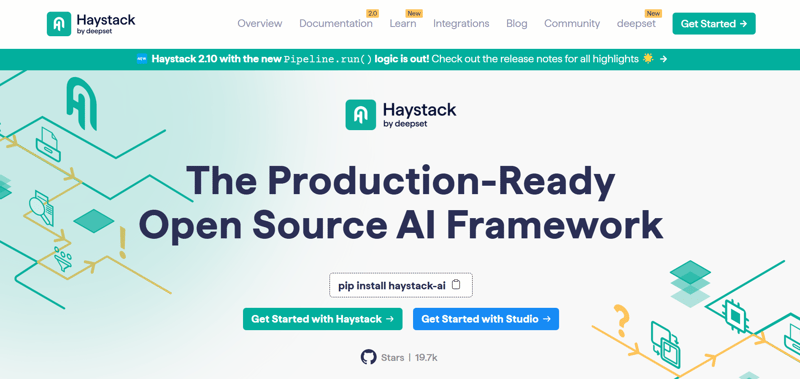
Haystack is an end-to-end LLM framework that allows you to build applications powered by LLMs, Transformer models, vector search and more. Whether you want to perform retrieval-augmented generation (RAG), document search, question answering or answer generation, Haystack can orchestrate state-of-the-art embedding models and LLMs into pipelines to build end-to-end NLP applications and solve your use case.
Core Features
Retrieval & Augmentation – Combines document search with LLMs.
Hybrid Search – Uses BM25, Dense Vectors, and Neural Retrieval.
Pre-built Pipelines – Modular approach for rapid development.
Integration Support – Works with Elasticsearch, OpenSearch, FAISS.
🔹Use Cases
AI-powered document Q&A
Context-aware virtual assistants
Scalable enterprise search
Why Haystack?
Optimized for production RAG applications.
Supports various retrievers & LLMs for flexibility.
LlamaIndex is the document processing platform for AI
🗂️ LlamaIndex (OSS Framework) 🦙
Note
The current focus of LlamaIndex is to build the best AI-powered engine for document parsing and extraction. LlamaParse is our enterprise platform for agentic OCR, parsing, extraction, indexing and more. LiteParse represents our efforts to build the best free, fast, cheap text parser in the market. ParseBench and ExtractBench represent our commitment towards open benchmarking for parsing and extraction.
The company itself has undergone an evolution since when this OSS framework first launched 3 years ago in 2023. Since the early days, the framework has consisted of a broad set of orchestration tools enabling developers to build various RAG and agent applications.
While we still have the OSS framework available as an open toolkit that you're welcome to use, our primary focus has shifted towards LlamaParse, along with liteparse and our benchmarking efforts. We have a strong belief that agents are the new consumers…
Jina AI is an open-source MLOps and AI framework designed for neural search, generative AI, and multimodal applications. It enables developers to build scalable AI-powered search systems, chatbots, and RAG (Retrieval-Augmented Generation) applications efficiently.
Core Features
Neural Search – Uses deep learning for document retrieval.
Multi-modal Data Support – Works with text, images, audio.
Vector Database Integration – Built-in support for Jina Embeddings.
Cloud & On-Premise Support – Easily deployable on Kubernetes.
☁️ Build multimodal AI applications with cloud-native stack
Jina-Serve
Jina-serve is a framework for building and deploying AI services that communicate via gRPC, HTTP and WebSockets. Scale your services from local development to production while focusing on your core logic.
Key Features
Native support for all major ML frameworks and data types
High-performance service design with scaling, streaming, and dynamic batching
LLM serving with streaming output
Built-in Docker integration and Executor Hub
One-click deployment to Jina AI Cloud
Enterprise-ready with Kubernetes and Docker Compose support
Comparison with FastAPI
Key advantages over FastAPI:
DocArray-based data handling with native gRPC support
Built-in containerization and service orchestration
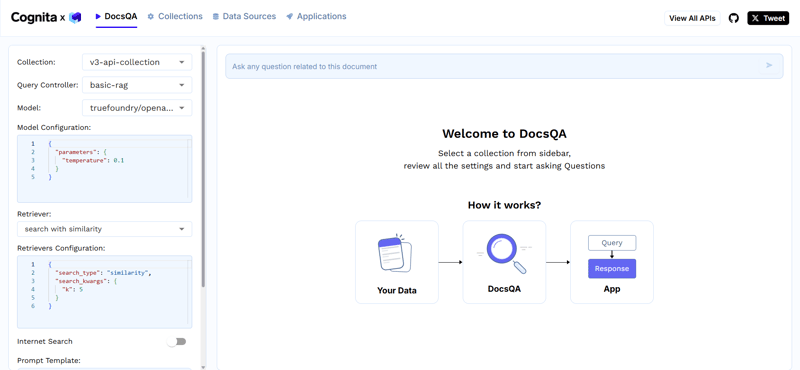
Cognita addresses the challenges of deploying complex AI systems by offering a structured framework that balances customization with user-friendliness. Its modular design ensures that applications can evolve alongside technological advancements, providing long-term value and adaptability.
RAG (Retrieval Augmented Generation) Framework for building modular, open source applications for production by TrueFoundry
Note
This project is no longer actively maintained. We thank all contributors for their contributions.
Cognita
Why use Cognita?
Langchain/LlamaIndex provide easy to use abstractions that can be used for quick experimentation and prototyping on jupyter notebooks. But, when things move to production, there are constraints like the components should be modular, easily scalable and extendable. This is where Cognita comes in action
Cognita uses Langchain/Llamaindex under the hood and provides an organisation to your codebase, where each of the RAG component is modular, API driven and easily extendible. Cognita can be used easily in a local setup, at the same time, offers you a production ready environment along with no-code UI support. Cognita also supports incremental indexing by default.
RAGFlow is an open-source Retrieval-Augmented Generation (RAG) engine developed by InfiniFlow, focusing on deep document understanding to enhance AI-driven question-answering systems.
Core Features
Deep Document Understanding: RAGFlow excels in processing complex, unstructured data formats, enabling accurate information extraction and retrieval.
Template-Based Chunking: It employs intelligent, explainable chunking methods with various templates to optimize data processing.
Integration with Infinity Database: RAGFlow seamlessly integrates with Infinity, an AI-native database optimized for dense and sparse vector searches, enhancing retrieval performance.
RAGFlow is a leading open-source Retrieval-Augmented Generation (RAG) engine that fuses cutting-edge RAG with Agent capabilities to create a superior context layer for LLMs
RAGFlow is a leading open-source Retrieval-Augmented Generation (RAG) engine that fuses cutting-edge RAG with Agent capabilities to create a superior context layer for LLMs. It offers a streamlined RAG workflow adaptable to enterprises of any scale. Powered by a converged context engine and pre-built agent templates, RAGFlow enables developers to transform complex data into high-fidelity, production-ready AI systems with exceptional efficiency and precision.
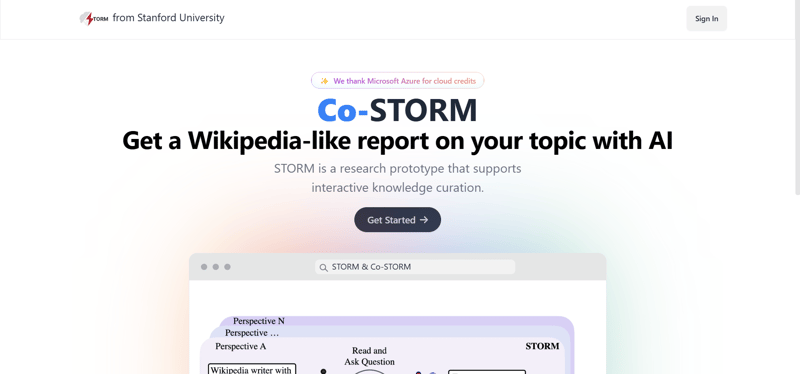
STORM is an AI-powered knowledge curation system developed by the Stanford Open Virtual Assistant Lab (OVAL). It automates the research process by generating comprehensive, citation-backed reports on various topics.
Core Features
Perspective-Guided Question Asking: STORM enhances the depth and breadth of information by generating questions from multiple perspectives, leading to more comprehensive research outcomes.
Simulated Conversations: The system simulates dialogues between a Wikipedia writer and a topic expert, grounded in internet sources, to refine its understanding and generate detailed reports.
Multi-Agent Collaboration: STORM employs a multi-agent system that simulates expert discussions, focusing on structured research and outline creation, and emphasizes proper citation and sourcing.
🔹Use Cases
Academic Research: Assists researchers in generating comprehensive literature reviews and summaries on specific topics.
Content Creation: Aids writers and journalists in producing well-researched articles with accurate citations.
Educational Tools: Serves as a resource for students and educators to quickly gather information on a wide range of subjects.
Why Choose STORM?
Automated In-Depth Research: STORM streamlines the process of gathering and synthesizing information, saving time and effort.
Comprehensive Reports: By considering multiple perspectives and simulating expert conversations, STORM delivers well-rounded and detailed reports.
Open-Source Accessibility: Being open-source, STORM allows for customization and integration into various workflows, making it a versatile tool for different users.
[2025/01] We add litellm integration for language models and embedding models in knowledge-storm v1.1.0.
[2024/09] Co-STORM codebase is now released and integrated into knowledge-storm python package v1.0.0. Run pip install knowledge-storm --upgrade to check it out.
[2024/09] We introduce collaborative STORM (Co-STORM) to support human-AI collaborative knowledge curation! Co-STORM Paper has been accepted to EMNLP 2024 main conference.
[2024/07] You can now install our package with pip install knowledge-storm!
[2024/07] We add VectorRM to support grounding on user-provided documents, complementing existing support of search engines (YouRM, BingSearch). (check out #58)
[2024/07] We release demo light for developers a minimal user interface built with streamlit framework in Python, handy for local development and demo hosting (checkout #54)
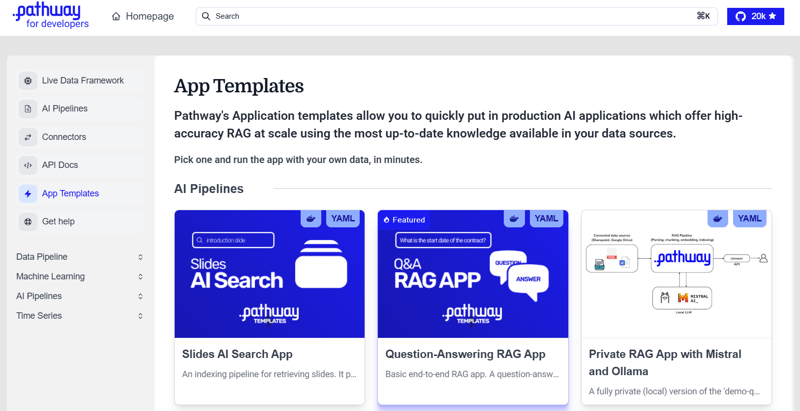
Ready-to-run cloud templates for RAG, AI pipelines, and enterprise search with live data. 🐳Docker-friendly.⚡Always in sync with Sharepoint, Google Drive, S3, Kafka, PostgreSQL, real-time data APIs, and more.
Pathway Live Data Framework AI Pipelines
The Pathway Live Data Framework's AI Pipelines allow you to quickly put in production AI applications that offer high-accuracy RAG and AI enterprise search at scale using the most up-to-date knowledge available in your data sources. It provides you ready-to-deploy LLM (Large Language Model) App Templates. You can test them on your own machine and deploy on-cloud (GCP, AWS, Azure, Render,...) or on-premises.
The apps connect and sync (all new data additions, deletions, updates) with data sources on your file system, Google Drive, Sharepoint, S3, Kafka, PostgreSQL, real-time data APIs. They come with no infrastructure dependencies that would need a separate setup. They include built-in data indexing enabling vector search, hybrid search, and full-text search - all done in-memory, with cache.
Application Templates
The application templates provided in this repo scale up to millions of pages of documents. Some of them…
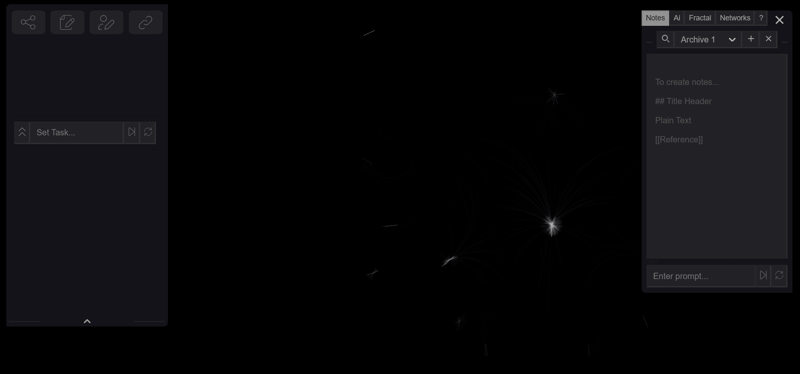
Neurite is an open-source project that offers a fractal graph-of-thought system, enabling rhizomatic mind-mapping for AI agents, web links, notes, and code.
Core Features
Fractal Graph-of-Thought: Implements a unique approach to knowledge representation using fractal structures.
Rhizomatic Mind-Mapping: Facilitates non-linear, interconnected mapping of ideas and information.
Integration Capabilities: Allows integration with AI agents, enhancing their knowledge management and retrieval processes.
🔹Use Cases
Knowledge Management
AI Research
Educational Tools
Why Choose Neurite?
Innovative Knowledge Representation: Offers a novel approach to organizing information, beneficial for complex data analysis.
Open-Source Accessibility: Allows users to customize and extend functionalities to suit specific needs.
Community Engagement: Encourages collaboration and sharing of ideas within the knowledge management community.
💡 neurite.network unleashes a new dimension of digital interface...
...the fractal dimension.
🧩 Drawing from chaos theory and graph theory, Neurite unveils the hidden patterns and intricate connections that shape creative thinking.
For over two years we've been iterating out a virtually limitless workspace that blends the mesmerizing complexity of fractals with contemporary mind-mapping technique.
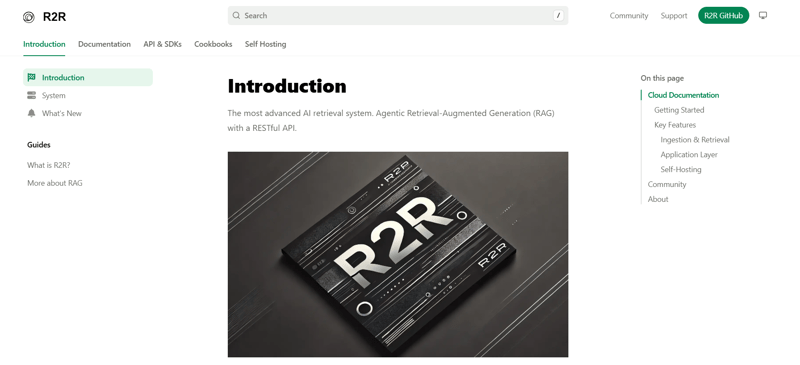
R2R is an advanced AI retrieval system supporting Retrieval-Augmented Generation (RAG) with production-ready features. Built around a RESTful API, R2R offers multimodal content ingestion, hybrid search, knowledge graphs, and comprehensive document management.
R2R also includes a Deep Research API, a multi-step reasoning system that fetches relevant data from your knowledgebase and/or the internet to deliver richer, context-aware answers for complex queries.
Usage
# Basic searchresults=client.retrieval.search(query="What is DeepSeek R1?")
# RAG with citationsresponse=client.retrieval.rag(query="What is DeepSeek R1?")
# Deep Research RAG Agentresponse=client.retrieval.agent(
message={"role":"user", "content": "What does deepseek r1
But wait, Why can't we use LangChain over RAG Frameworks??
While LangChain is a powerful tool for working with LLMs, it is not a dedicated RAG framework. Here’s why a specialized RAG framework might be a better choice:
LangChain helps connect LLMs with different tools (vector databases, APIs, memory, etc.), but it does not specialize in optimizing retrieval-augmented generation (RAG).
LangChain provides building blocks for RAG but lacks advanced retrieval mechanisms found in dedicated RAG frameworks.
LangChain is good for prototypes, but handling large-scale document retrieval or enterprise-level applications often requires an optimized RAG framework.
Conclusion: Choosing the right framework 😉
With a variety of open-source RAG frameworks available—each optimized for different use cases—choosing the right one depends on your specific needs, scalability requirements, and data complexity.
If you need a lightweight and developer-friendly solution, frameworks like txtAI or LLM-App are great choices.
For enterprise-scale, structured retrieval, LLMWare, RAGFlow, LlamaIndex, and Haystack offer robust performance.
Jina AI and Neurite are well-suited for the task if you focus on multi-modal data processing.
For reasoning-based or knowledge graph-powered retrieval, Cognita, R2R, and STORM stand out.
Finally, we are at the end of the blog. I hope you found it insightful. Please save it for the future. Who knows, when you need it!
Hi there!🧟
You're the most beautiful person I've ever met! - RS-labhub
github.com
Thank you so much for reading! You're the most beautiful person I ever met. I have a lot of trust in you. Keep believing in yourself, and one day you will become motivation for others. 💖




















-DFE0E5)





























 github.com

